

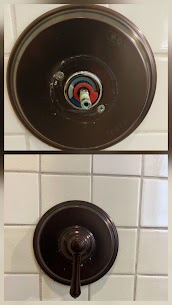
Start With Diagnosis, Not Replacement
Weak shower pressure and lukewarm water are usually caused by a short list of issues that can be checked before replacing the fixture: partially closed shutoff valves behind the handle, a restriction at the shower head, an anti-scald limit set too low, or low incoming house pressure.
A homeowner recently called with both symptoms at once. The shower had weak flow and the water never got properly hot. They expected the valve itself might need replacement, so the first step was to diagnose the system in order.
What Robert Checked, in Order
1. Measure the incoming water pressure
Before touching the fixture, determine whether the problem is isolated to the shower or affects the house. If pressure is low everywhere, the shower is a symptom rather than the root cause.
2. Remove the handle and faceplate
Disassembling the handle and removing the faceplate exposes the valve assembly and the integral shutoff valves found behind many modern shower cartridges.
3. Open the internal shutoffs fully
Small screwdriver-slot shutoffs inside the valve body can be left partially closed after earlier service work. Opening them fully can restore flow when the rest of the plumbing is working normally.
4. Check the shower-head restriction
A shower head can have a restrictive insert or mineral buildup that reduces flow. On this service call, the restrictive insert was removed to improve flow. Water-efficiency rules and product requirements vary, so any change should be made with the fixture specifications and local requirements in mind.
5. Adjust the anti-scald limit stop
Modern shower valves commonly include a rotational limit stop that limits how far the handle moves toward hot. If it is set too conservatively, the shower can feel warm without ever getting properly hot. The setting must be adjusted carefully because its purpose is to reduce scald risk.
Why Replacing the Valve Shouldn't Be the First Move
Replacing a shower valve can mean opening the wall and creating additional drywall, tile, and finish work. Sometimes replacement is necessary, but basic pressure and temperature checks should come first.
When the Problem May Be Bigger
- Only one fixture is affected and basic checks change nothing: a failed or scaled cartridge may be involved.
- Every fixture is weak: the issue may be the pressure regulator, main shutoff, or supply piping.
- Hot water runs out quickly throughout the home: the water heater may be the issue rather than the shower.
- Pressure dropped after other plumbing work: a valve may have been left partially closed.
- Discolored water or grit appears: sediment or a supply-side issue needs further diagnosis.
Frequently Asked Questions
Why is my shower pressure suddenly low?
One common cause is a partially closed internal shutoff behind the shower handle. A clogged or restrictive shower head can also reduce flow.
Why does my shower never get hot enough?
The anti-scald limit stop inside the handle assembly may be set too conservatively, limiting how far the handle can rotate toward hot.
Do I need a plumber or a handyman for low shower pressure?
Fixture-level troubleshooting such as shutoffs, shower-head restrictions, limit-stop adjustment, and cartridge checks can often be handled as handyman work. House-wide pressure, repiping, or work behind the wall may require a licensed plumber.
Can this be checked without opening the wall?
Often, yes. The pressure, internal shutoffs, shower head, and anti-scald setting can all be checked before deciding whether wall access is necessary.
Get It Diagnosed Before You Replace It
Robert Lapointe and Homeowner Handy handle plumbing fixture troubleshooting, repairs, and installations across Mountain View and nearby Bay Area communities. Call or text (650) 224-8460 and describe the symptoms before you start replacing parts.